
Advocacy: Socio and Economic Justice
By Teresa Kenney
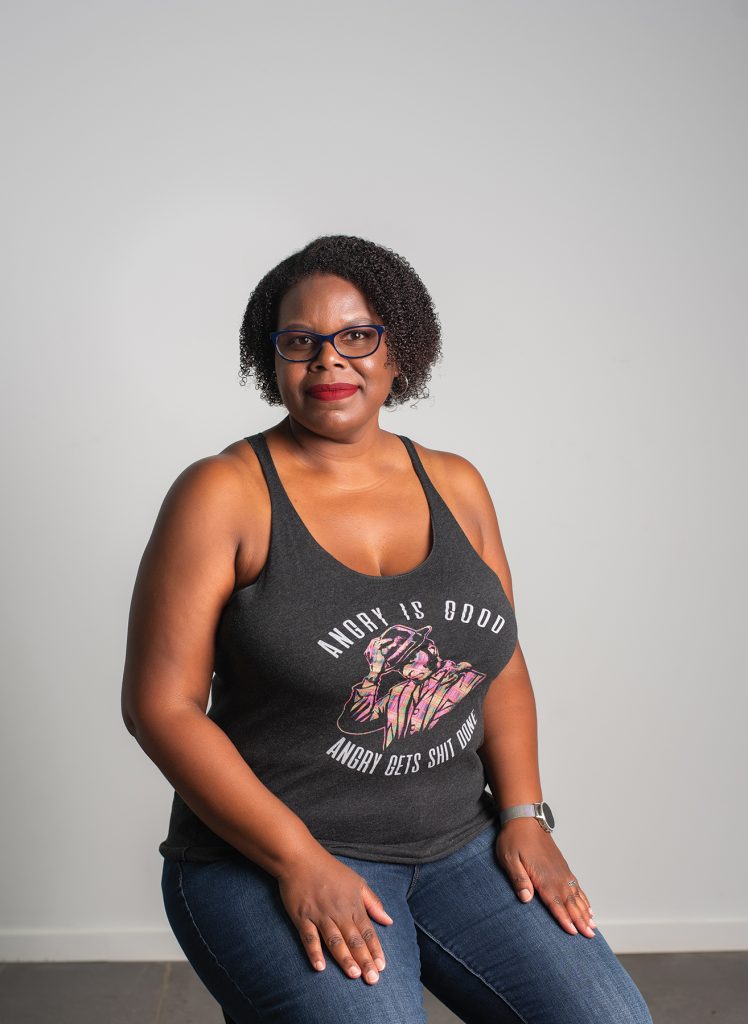
STYLED BY SHE’S LEGEND TEAM
ART DIRECTION BY WOODLANDS CREATIVES
Don’t expect to find Deanna Adams in front of the camera or behind the podium on the stage. Although she’s happy to step into the spotlight if it will help any one of the causes she supports, she prefers to do her work behind the scenes. Adams works with Black Lives Matter Houston and articulates her thoughts on the intersection of race and religion in her blog “Musings on a Limb.” She also wrote a chapter for Karen Garst’s book, Women V. Religion: The Case Against Faith and For Freedom, published in 2018.
“I’m definitely more of a behind-the-scenes person, and I like it that way. Some of us prefer to get the bullhorn and are better at doing that and speaking to people and getting them to understand the issues quickly. Then others of us—well—I’m a writer first,” she notes.
She’s also a single mom of three, which makes her unflagging desire to help others so remarkable. The Texas native and lifelong Houstonian (she was born here, grew up here and attended college here) started volunteering at a young age and never looked back.
With so much to discuss and so little time to do the discussing, we focused in on yet another passion of hers: West Street Recovery. The grassroots organization evolved out of the destruction left in the wake of Hurricane Harvey in 2017. To date, it has helped to rebuild some of the hardest hit—and most quickly forgotten post-hurricane—neighborhoods in Houston. Through West Street, some 200 households have received direct material assistance, and 6 homes have been fully repaired.
Adams shared with us her thoughts on her life, her advocacy and her love of Prince.
On how her double college major in economics and psychology is really just a reflection of her personality.
All along in my life it’s been a forever struggle between my practical side and my passionate side. In college, I had always taken a lot of psychology classes because it was interesting, and economics was actually part of the same social sciences department, so I realized that I could double major. The economics would show the bigger picture for me—seeing how the government, how labor, how people, how companies worked. With my other classes, I’d have the psychology behind it all. It was a really good mix for me, and I learned a lot that I still use.
On her natural inclination to help.
I’ve always considered myself a helper. Just always. When I was a child, I would help around the house at my grandmother’s or aunt’s or whoever I was around. I was always that kid [who helped]. And my mom worked for Exxon when I was little, so we would do a lot of volunteer activities with the company.
One of the earliest memories I have of volunteering was a Christmas program with a group home. I was reading stories to the residents. That same year, we helped paint Sam Houston Park downtown. It’s a historical collection of some of the older homes that were in Houston in the 1800s. On a side note: One thing about Houston is we do not respect history very well at all. It’s kind of sad. But it’s why there are new restaurants in town every three months, and places are being torn down that have been around for 50 years or so. It was really cool to help restore some of the history instead of tearing it down.
On what fully activated her “She’s Legend” badassness.
I was a freshman in high school when the Rodney King beating happened, and that pretty much was the start of me paying attention to racial dynamics. [Editor note: In 1991, Rodney King was brutally beaten, stomped and taunted by Los Angeles police officers. The attack was videotaped by a bystander and was broadcast by major news organizations around the world. The four officers charged in the beating, however, were later acquitted, sparking outrage and violent protests in the community. King repeatedly called for peace and went on to become an activist later in life. He died of an accidental drowning in 2012.]
I knew about racial dynamics before the Rodney King beating; I was always aware. I had an aunt who was very Afrocentric, and she would teach me a lot. But when that particular incident happened, and I saw the fallout from it, that was an eye-opening experience, as I was coming of age anyway. It was an interesting time for me for that to happen. That’s when I first remember speaking out.
On helping to found West Street Recovery.
The way [West Street Recovery was started] was interesting: There wer three roommates renting a house on West Street in northeast Houston, and they had a boat. They were in their late 20s, early 30s. [After Hurricane Harvey], a lot of their neighbors were stuck, flooded, and stranded on rooftops. So the three roommates took the boat and went out to rescue their neighbors. Once they got the people out of the situation, the question became, “Okay, now what do we do? We can’t just leave them here. We need to feed them, and we need to help them. We need to continue to help.”
At the same time, another person who is still involved with West Street, was stranded in her home on the south side of Houston. She was flooded in, but she wasn’t harmed. She just couldn’t get out to help people. What she did is get on Facebook and on social media and helped with getting rescuers dispatched to where they needed to go. And my home was fine, thankfully, so we went and purchased supplies and went to the shelters. I also helped to organize a day of volunteer action, where we got more than 100 volunteers through Black Lives Matter Houston and Facebook to come out to northeast Houston.
So all of these different pieces came together to make West Street Recovery. I did the behind-the-scenes volunteer recruitment effort and someone else canvassed the 10-block area that we were going into. We took her list, my organization, others’ know-how on how to muck and gut a water-damaged home, and put them all together, sending teams of five volunteers out to different homes for about two or three weeks in a row and got people started on recovery.
After that, it was like, “Okay, well, this isn’t over,” and so the organization was born. I eventually became one of the first case managers for West Street Recovery. Now I am on the board. It’s a horizontal organization, so my role is as an advisor.
On who inspires her.
Everyday people who aren’t necessarily seeking the spotlight inspire me. If we all do something, we could be so much further along in becoming a better people, nation, world, etc.
On what she would like to be remembered for.
I would love to be remembered as someone who truly cared, whether it ultimately makes a difference or not. In the advocacy world, sometimes we are judged solely by our last win or defeat. If I’m to be remembered at all (which doesn’t matter a great deal to me), I hope it’s because I accomplished things that made people’s lives better.
On what she has on her revolutionary playlist.
That one’s easy. Anyone who knows me, knows that I am a huge Prince fan. He wrote a lot of songs about revolution and changing the world, but the first one that comes to mind is “We March.” It’s on his Gold Experience album. •