
Advocacy: Gun Safety
By Teresa Kenney
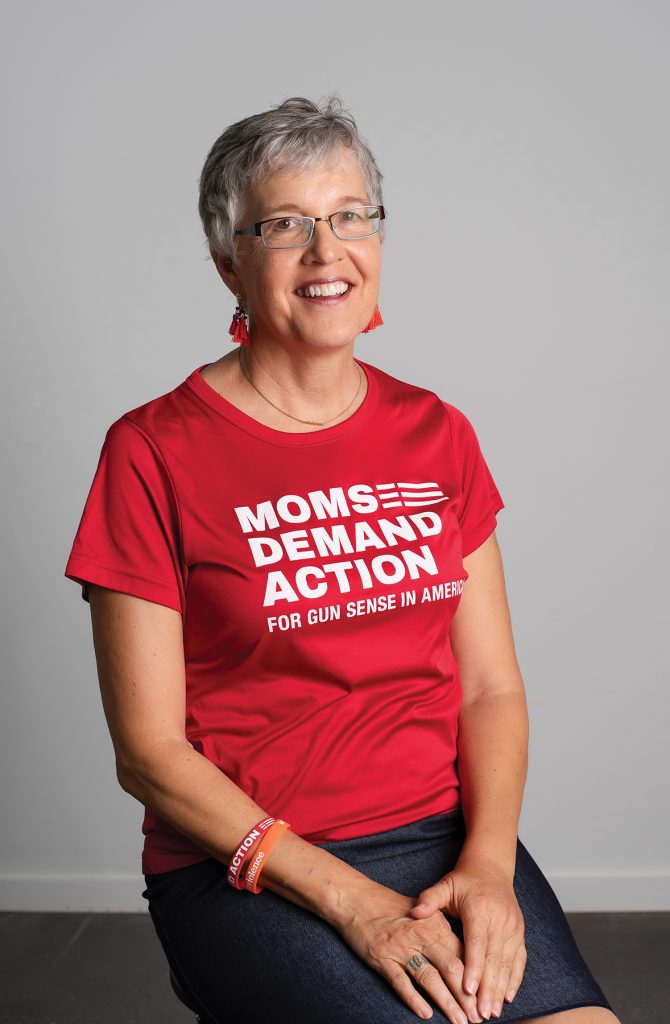
STYLED BY SHE’S LEGEND TEAM
ART DIRECTION BY WOODLANDS CREATIVES
Fresh from graduating from Ohio Wesleyan University, Jane Kelso Winter moved to Washington, D.C. to work at Georgetown University as director of employment services. It was the mid 1980s—the decade of Ronald Reagan, the Iran-Contra affair, and the meltdown of both the Cold War and Chernobyl. Living in D.C. at this time in history (or any time, really) would activate anyone’s latent advocacy powers and Winter was no different. She’d strap her son into his stroller and head out on a march. She volunteered for the National Organization of Women, and she protested the secret sale of arms to Iran. Eventually, she left the university and joined the staff of Handgun Control, Inc., a precursor to the Brady Center to Prevent Gun Violence.
That was then.
Today, Winter lives approximately 30 minutes north of Houston and her focus is still the same. What’s changed is now she’s a volunteer and not on the payroll. She’s a local group leader for the Spring/Woodlands Moms Demand Action for Gun Sense in America. What’s also changed is now she’s a survivor of gun violence. One summer day, She’s Legend joined Winter on the back porch of her home in The Woodlands to find out where her activism stems from. (This interview has been edited for space and clarity.)
Do you feel like your activism is more nature or nurture? Did you come out of the womb holding a marker and poster board or did something happen that spurred that in you?
I think it’s a combination because my mom was always doing things in the community. We didn’t really call it activism then. When she got divorced, the feminist movement was just sort of making its way to semi-rural Ohio. And I watched that. I watched her have to go through a divorce and not have credit in her own name and all the things that came with that. So I was seeing that, but activism wasn’t particularly my first inclination. And then when I got to college there were some people I admired who were also doing cool little bits. I wasn’t a super activist, but I was drawn to people who were.
When you went to work for the Brady Center, the environment in the country was very different. James Brady had been shot, but we hadn’t experienced the mass shootings that we unfortunately see so regularly today.
Right. At the beginning of my tenure, the organization was called Handgun Control, Inc. and they were for a seven-day waiting period—which they called a cooling-off period—and background checks. That was basically the whole organization’s existence. Assault weapons were not on the radar.
Or high-capacity magazines.
Right. That wasn’t really in people’s vocabulary when I started there—by 1994, however, we had passed a ban on military-style assault weapons. The center hired me as a community organizer. They didn’t have chapters, but we had people who wanted to get involved. It kind of evolved into me being the point person for what we called “victims” then—now, we call them survivors of gun violence. They would call and want to talk with somebody—want to do something. And the [staff at Handgun Control] would say, “Well, let’s give them to Jane.”
So I started talking to a lot of survivors all across the country. I did that plus the grassroots organizing of people—getting them involved in state legislation, city councils, just whatever they wanted to do. And, of course, getting them involved in our federal legislation was our big push. The Brady Bill was the big focus. And that’s what I did until I moved to Houston.
Did you continue the work in Texas?
I worked with a local group that was working closely with the Brady Center but it wasn’t a chapter. Then I took a bit of a break. We moved to Canada. And when I came back I had lost my son to gun violence. He took his own life with a firearm—a handgun. He passed away in March of 2010; we were still living in Canada. When I came back, I asked a friend of mine who I’d worked with at Brady, “Who have you seen that’s really doing awesome stuff in the gun violence prevention network?” And she mentioned what was then called Mayors Against Illegal Guns. And so I plugged myself into them. Moms Demand Action was founded by Shannon Watts as its own entity, but it merged with Mayors Against Illegal Guns and became Everytown for Gun Safety.
I didn’t realize those were two connected organizations.
Yes—they’re connected. The research arm is Everytown for Gun Safety. But what I call the boots on the ground are the moms out there doing all the work through Moms Demand Action.
Who do you admire in activism or who has inspired you?
It’s a multiprong answer. I’m always amazed by people who are volunteer activists. I mean, I guess I am one. But when I was getting paid for it I thought, “My job is so much easier. I get to go home at the end of the day, and I don’t have to go to the state legislatures and wait for hours to give, perhaps, two minutes of testimony. I don’t have to actually confront somebody face-to-face and try to convince them.” So I was inspired before I moved out to Houston by the people who were doing that volunteer activism.
I was also inspired by people like Ann Richards and her daughter, Cecile Richards. I’ve been inspired by Shannon Watts, who has never taken a salary and at great peril to herself and her family continues to speak out about [gun violence] and continues to be vocal.
And then the women who work with me now in this group inspire me to keep going. I feel a responsibility to younger activists to show the way. We don’t have to do it all by ourselves. It’s a long stretch. I don’t get nearly as disappointed by small setbacks because I’ve been in it for so long. Sadly, it’s the same arguments from the gun lobby since I started, and we still lose almost 100 people a day to gun violence. It’s nothing new to me, but I find it extremely frustrating.
And I have to say I was inspired by Sarah Brady. She came to the issue when nobody else wanted to talk about it. Her husband was Republican. He was in, basically, mortal danger his entire life because he had a bullet in his brain. And he also had massive health challenges. She used to get quite beaten up by the NRA, personally, like Shannon does. Politically you can take that, but when it gets personal that’s a tougher thing. And she kept going; she never gave up. Her entire life until she passed away she was still speaking out. So that’s pretty inspiring.
What’s your hope? Is there a time when you’re going to say, “We won”?
I do hope that there does come a time that we can say, “Look at all we’ve accomplished.” I don’t know in this country if we’re ever going to be able to say, “We won.” I think there will always be a struggle, and I wish that weren’t true. [Although] I feel we’ve won with all the people we’ve brought into the movement.
I would like to see the culture change where people say, “I’m a responsible gun owner. I’m going to keep my gun unloaded and locked up. We’re not going to have accidental deaths or accidental shootings. We’re going to reduce the number of suicides from easy access to weapons.” I would love to see that little bit of a cultural shift. I’m not sure if I will get to a point where I can say that we’ve actually won. But if we make strides, I think we win. •