
Advocacy: Politics
By Teresa Kenney
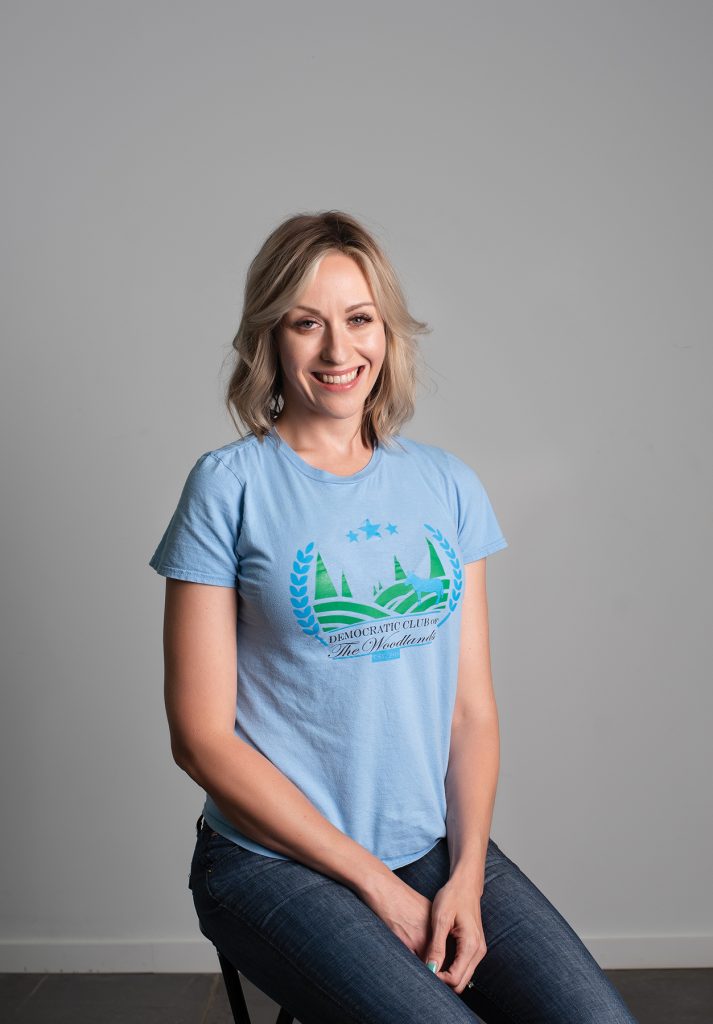
STYLED BY SHE’S LEGEND TEAM
ART DIRECTION BY WOODLANDS CREATIVES
If you live in The Woodlands, a well-heeled suburb north of Houston, you can thank Robin Fulford and local activists like her for the unexpected influx of bumper stickers, yard signs and block walkers in support of Beto O’Rourke during his 2018 campaign against incumbent Ted Cruz. (Not to mention the “Resist,” “#Impeach,” and “Facts Matter” stickers that have lingered long after.) Fulford cofounded the Democratic Club of The Woodlands with fellow activist Jennifer Masella Blackman. The club is a welcome oasis for liberals and progressives in Montgomery and north Harris counties. In fact, it’s helping to turn this ruby red county—if not exactly blue—a perfectly pleasant shade of purple, and with Fulford’s lead is encouraging area Democrats to raise their voices above a whisper. She walks her talk— “When we hide our Democratic values, we are doing everyone a disservice,” she notes—and as a result has found herself on the receiving end of threats.
Following the club’s first successful fundraising gala—which featured guest speaker MJ Hegar (who is running for Senator John Cornyn’s seat in 2020) and surpassed its goal of raising of $19,000—Fulford sat down with us to talk about what drove her to found the Democratic Club of The Woodlands and what spurs her activism. (This interview has been edited for flow, clarity and space.)
Why did you start the Democratic Club of The Woodlands?
After Trump’s election, I was trying to figure out what I could do to change things. I had promised [my son] Mason that I would do everything in my power to counter Trump and help the people that we care about. I was listening to The 45th Podcast with Rabia Chaudry. Michael Dukakis was a guest, and he was saying that the key to winning elections are precinct chairs.
So I became a precinct chair, and I started going to the Harris County Democratic Party meetings. They were talking a lot about local clubs and organizations, and Lillie Schechter, the Harris County party chair, said that that’s where the grassroots efforts really happen. I realized that The Woodlands not having an active club put us at a major disadvantage—especially as [our community] considers incorporation, which would require us to elect a city council. The Democrats in the community were kind of separated, and we needed something as an umbrella to bring us together.
At first, I didn’t think that I would have a very important voice. Why should my voice be more important than anybody else’s? And it’s not. I just don’t have anything to lose for being vocal. When we first moved here, I tried to meet people in my neighborhood, and I was not embraced because I’m not religious and don’t go to a church. Even though I said I celebrate people and support friends of all different faiths, I wasn’t accepted. As we were figuring out what activism would mean in The Woodlands, I realized that me not blending in anyway made it a lot easier for me to be vocal.
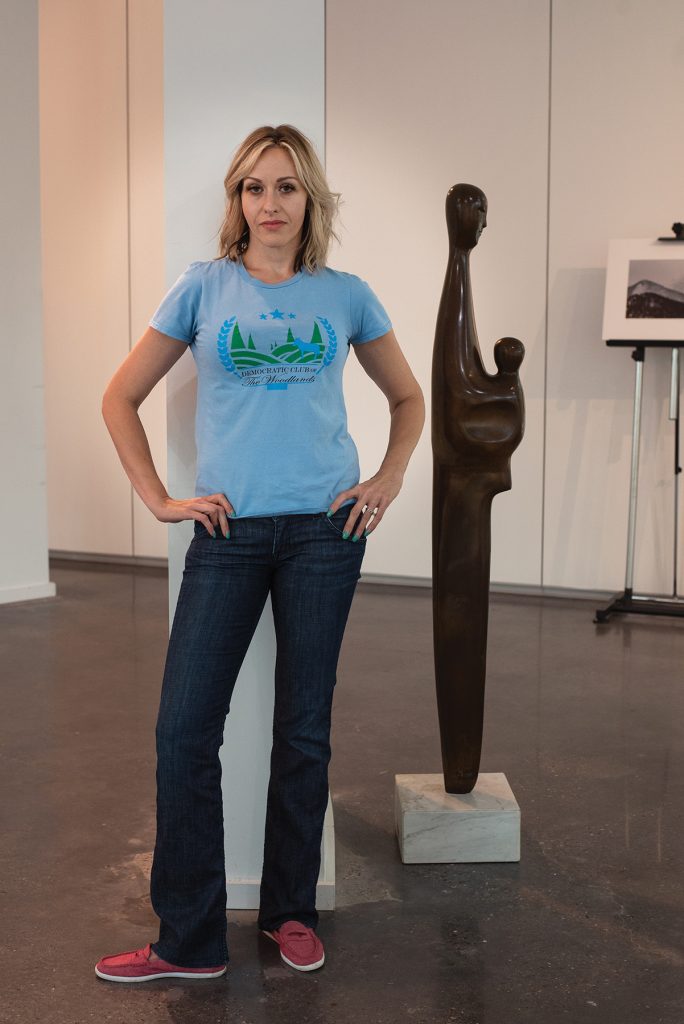
STYLED BY SHE’S LEGEND TEAM
ART DIRECTION BY WOODLANDS CREATIVES
So your not fitting in gave you the freedom to be who you are?
Exactly. I just said, “Well I’m happy with the person I am. I know that I’m a good person. I know that I’m educated. And I am not concerned about voicing my beliefs.” So it made it so much easier to speak out.
Where does your activist spirit come from?
I grew up right outside of Baltimore, and I went to a Montessori school in Annapolis. I remember talking about race and discrimination from a very early age with my family. My parents were hippies. And I remember watching documentaries at school about early protests and seeing Black people being sprayed with high-power hoses. And I was horrified as a kid. And one of my teachers was Jewish, so we talked about the Holocaust. And I just thought that, “If I was alive back at that time, what would I have done?” I said to myself I would be somebody who would stand up. I just would. I would not stand around and let that happen.
I have a mother who’s very empathetic, and I was always taught to think about how other people feel. I wasn’t raised with religion, but I was raised on “you treat other people the way you want to be treated.” And that you need to think about how others feel, always. When you’re raised with that from an early age—and I do that with my own children—it makes you feel compelled to speak out when things are happening that you know are not okay. I see that with my son. I always ask him to think about how other people are feeling. And naturally, when we talk about things regarding race or religion, he is more compelled to speak up against discrimination.
As I’m meeting other people and working with likeminded groups, I’m speaking to a lot of people who are passionate about the same exact things. And usually when we first meet they don’t really see themselves as a leader, but they could be. I think part of being an activist leader is building up people’s confidence to make them feel like, “We are behind you. And if you use your voice to speak up, we will be right alongside you.”
As far as other activists or people who inspire you, whether they’re around now or from the past, who do you look to as inspiration?
Congressman John Lewis. Watching him and the sacrifices that he has had made, along with Martin Luther King Jr., Malcolm X, and Harvey Milk—anyone who has sacrificed for what they believe in—inspires me. Seeing what they went through makes you feel ridiculous about worrying if people won’t like you if you speak up. That’s stupid if you look at it in comparison to people who have gone to jail and lost their lives trying to create change. Change does not happen if you just sort of suggest it or if you never do anything to affect it. Once when I was tired from all the political activity, I spoke to one of my friends—a person of color—and he said, “Wow, it must be nice, it must be a luxury to be able to say, ‘This is really tiring.’” Because if you don’t have a choice, you’re always fighting injustice. I always think about that when I feel like I’m getting tapped out. •